Clamp Meter vs Multimeter: Which Do UAE Electricians Need?
A clamp reads load current without breaking the circuit. A multimeter reads voltage, resistance and small currents better. Here is when to use each.
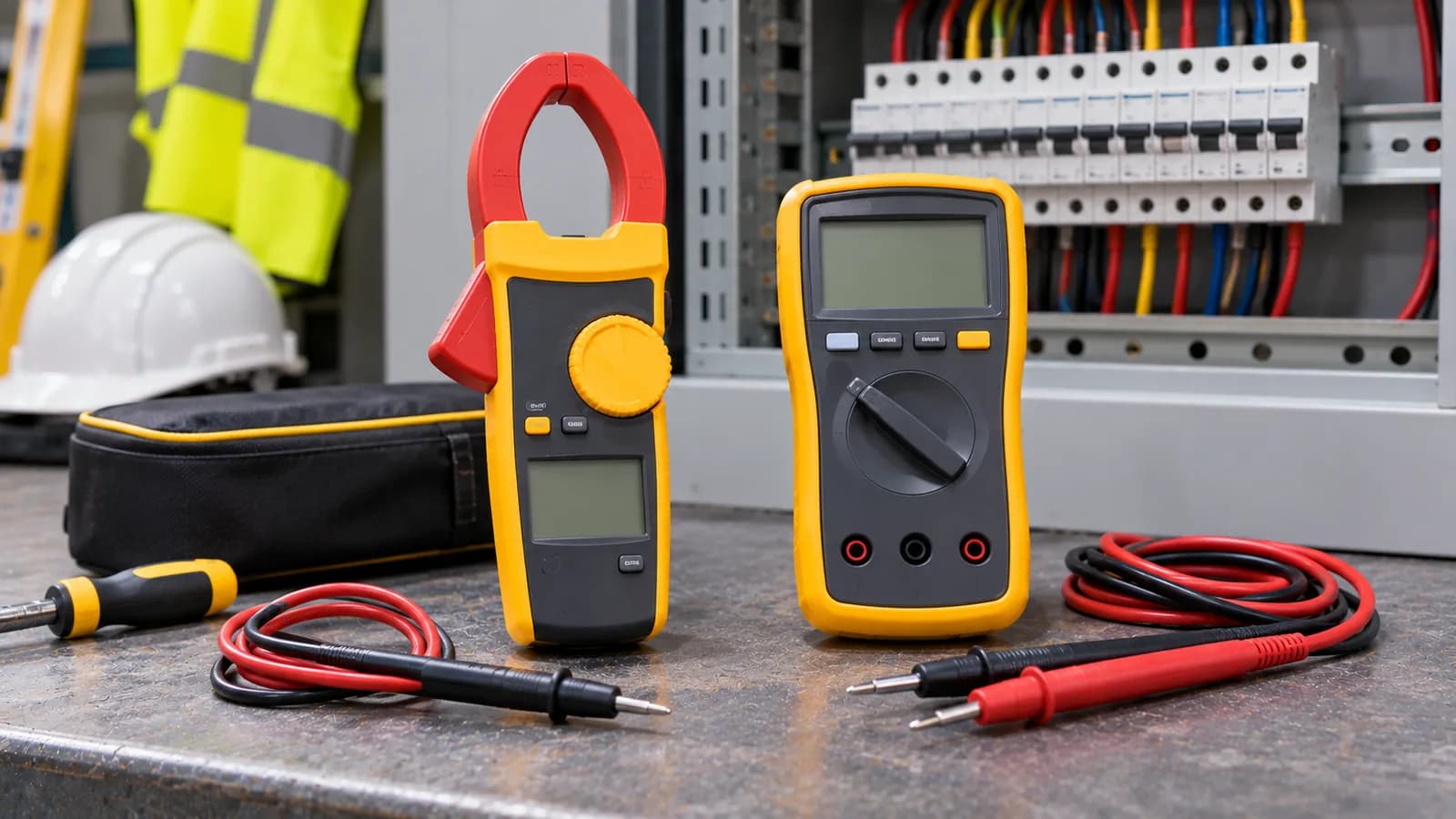
Buy a clamp meter if most of your work is measuring load current on live circuits. Buy a multimeter if it is voltage, resistance and small currents. Most working electricians in the UAE carry both, because each one is weak where the other is strong.
The two instruments overlap more than they used to. A modern clamp reads voltage and resistance, and a multimeter reads current. The difference is how they measure current, and that decides which one belongs in your hand for a given job.
How each one measures current
A multimeter measures current in series. You switch off, break the circuit, connect the meter into the gap and switch back on, so the full load current runs through the meter. That limits you to what its input can take: the Fluke 117 and Fluke 179 both stop at 10 A. A 63 A feeder in a distribution board is out of the question.
A clamp meter measures the magnetic field around a conductor. You close the jaws around one core and read the display, and the circuit keeps running. Nothing is disconnected and no current passes through the instrument, which is why a Fluke 323 can read 400 A from a body that fits in a tool pouch.
Clamp one conductor at a time. Around a whole cable, the fields from line and neutral cancel and the display reads close to zero.
Side by side
| Clamp meter | Multimeter | |
|---|---|---|
| Measuring current | Around the conductor, circuit stays live | In series, circuit is broken |
| Top of the current range | 400 A on the 323, 999.9 A on the 376 FC jaw | 10 A on the 117 and 179 |
| Small currents | Poor below a few amps, unless it is a leakage or milliamp clamp | Good, and some models read microamps |
| DC voltage accuracy | Adequate for checks | 0.09% on the 179, 0.05% on the 87V |
| Low resistance and millivolts | Limited | Good |
| Best for | Load checks, phase balance, motor running current | Fault-finding, control circuits, proving ghost voltages |
Why a clamp reads poorly on small loads
A clamp built for hundreds of amps has coarse resolution at the bottom of its range, and the accuracy figure shows it. The Fluke 323 is specified at 2% ±5 digits on its 400.0 A range. Each digit is 0.1 A, so at a 2 A load the possible error is about ±0.54 A, or more than a quarter of the reading.
The 117 measures the same 2 A in series on its 10.00 A range at 1.5% + 3 digits, which works out at about ±0.06 A. If you are comparing a small fan or a control transformer against its rating, that difference matters. If you are checking whether a 200 A feeder is overloaded, it does not, and the clamp is much the better tool.
When the clamp is the right tool
- Checking the load on a live feeder or sub-main without an outage.
- Comparing phase currents on a three-phase board. When single-phase loads are spread across the phases, an uneven split is a common finding.
- Reading a motor's running current against its nameplate.
- HVAC compressor and fan checks. The Fluke 324 adds temperature and capacitance, and the Fluke 902 FC adds microamps for flame sensors.
- Busbars and cable bundles the jaw will not close around. The Fluke 376 FC ships with an iFlex probe that reads up to 2,500 A AC.
Earth leakage is the one job where you deliberately clamp line and neutral together. On a healthy circuit they cancel, and whatever is left is current escaping to earth. A standard clamp cannot resolve that, so use a leakage clamp such as the Fluke 369 FC, which reads milliamps and is the quickest way to trace nuisance RCD tripping.
When the multimeter is the right tool
- Proving a ghost voltage. On long parallel runs a dead conductor can show 60 V or more on a high-impedance meter. The 117's low-impedance mode bleeds that off so the reading falls to near zero.
- Measuring on variable frequency drives. The Fluke 87V has a low-pass filter that settles the reading on the chopped output of a drive.
- Low-level control circuits, sensors and small DC supplies, where you need the resolution.
- Flame sensor current on HVAC plant. The Fluke 116 reads microamps.
- Continuity and resistance on terminations, where a clamp's resistance range is too coarse.
Check the safety rating on both
The CAT rating is a separate decision from the measuring range. The Fluke 323, 324 and 325 are rated CAT III 600 V / CAT IV 300 V, and the 117 is rated CAT III 600 V. The 376 FC, 87V and 179 are rated CAT III 1000 V / CAT IV 600 V. If you work at the main incomer or on outdoor supply cables, you need the higher rating, whatever the range on the dial. Your test leads need the same rating as the meter.
What to buy, by trade
| Work | Multimeter | Clamp meter |
|---|---|---|
| Fit-out and building services | Fluke 117 | Fluke 323, or the 117/323 combo kit for both |
| Plant, panels and drives | Fluke 87V | Fluke 376 FC |
| HVAC service | Fluke 116 | Fluke 324 or 902 FC |
| General facilities maintenance | Fluke 179 | Fluke 324 or 325 |
You can see the rest of the range on our Fluke page. We also hold Kyoritsu, Hioki, Megger and Uni-T in the clamp meters category if you are equipping a crew on a tighter budget.
Common questions
Can a clamp meter replace a multimeter?
For some electricians, yes. The 376 FC reads AC and DC voltage to 1000 V, resistance to 60 kΩ and capacitance to 1000 µF, so it covers a lot of a normal day. It is still not the tool for millivolt readings or low-ohm continuity, and it has no low-impedance mode for ghost voltages.
Why does my clamp read zero around a live cable?
You have clamped the whole cable. Line and neutral carry equal and opposite currents, so their fields cancel. Separate one core and clamp only that.
Do I need a true-RMS clamp?
Yes, if you measure anything other than plain resistive loads. LED drivers, drives and switching power supplies draw distorted current, and an averaging meter reads it wrongly. The 323, 324 and 325 are all true-RMS.
Which clamps measure DC?
In the 320 series, only the 325. The 374 FC, 375 FC, 376 FC and 377 FC also read DC. For solar strings, use the Fluke 393 FC, which is rated CAT III 1500 V DC.
Buying in Dubai
All the models above are stocked at our counter on Naif Road, Deira. You can collect the same day, or we deliver across the UAE in one to two working days. We are a supplier and stockist, not an authorised distributor. Send a model number on WhatsApp and we will reply with a price the same working day.