Fluke 1662 vs 1663 vs 1664 FC: Which Installation Tester?
All three test loop, RCD, continuity and insulation. The 1664 FC adds PreTest and Auto Test, and the 1663 adds earth resistance by the loop method.
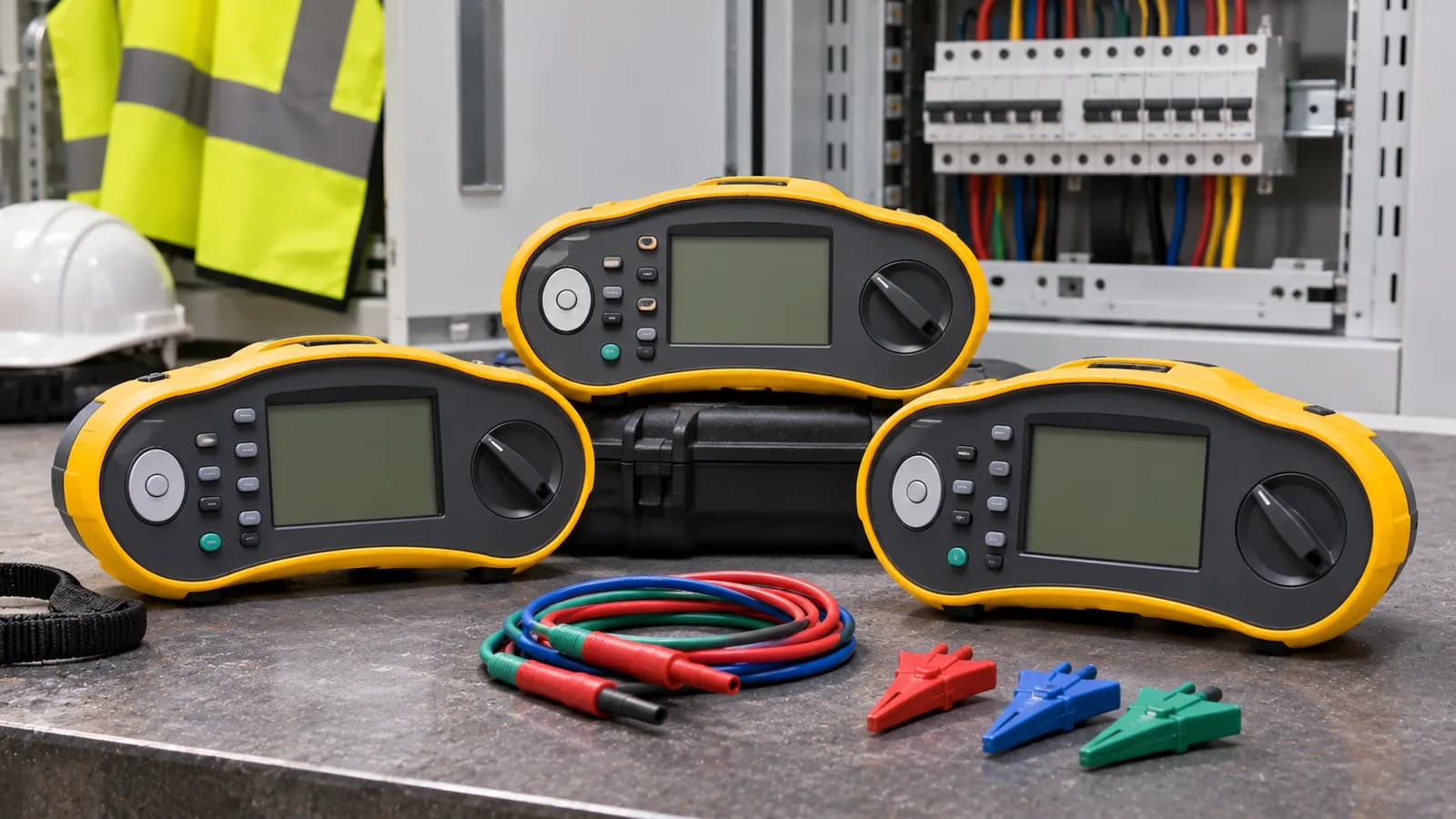
Buy the Fluke 1664 FC if you test often and want protection against damaging connected equipment. Buy the 1663 if you need earth resistance by the loop method and a 50 V insulation range. Buy the 1662 if you want the core certification tests at the lowest cost in the series.
All three are multifunction installation testers, so each one replaces a separate continuity tester, insulation tester, loop tester and RCD tester. The differences sit in a few specific functions. Here is what they are and which jobs they change.
Side by side
| Fluke 1662 | Fluke 1663 | Fluke 1664 FC | |
|---|---|---|---|
| Insulation test voltages | 100, 250, 500, 1000 V | 50, 100, 250, 500, 1000 V | 50, 100, 250, 500, 1000 V |
| Continuity, loop and RCD testing | Yes | Yes | Yes |
| RCD types | A, AC, G, S | A, AC, G, S | A, AC, B, S |
| Earth resistance by loop method | No | Yes | Yes |
| Insulation PreTest | No | No | Yes |
| Auto Test sequence | No | No | Yes |
| Fluke Connect wireless | No | No | Yes |
RCD type support varies by version and accessory, so confirm the exact variant on the quotation if you test a particular type.
What the 1664 FC adds
Insulation PreTest
This is the main reason to pay more. Before it applies the test voltage, the tester checks whether an appliance or load is still connected to the circuit. If it finds one, it stops the test and warns you. On a fit-out, where a dimmer, a driver or an SPD may have been connected after the last check, that can save you from sending 500 V or 1000 V into electronics that will not survive it.
Auto Test
Auto Test runs seven installation tests in one sequence from a single connection. On a board with many circuits, this cuts the number of times you reconnect the leads and turn the dial. The saving is small on one circuit and large on a whole floor.
Type B RCD testing
Type B RCDs detect smooth DC residual current. They are used on circuits such as EV chargers, some PV systems and variable speed drives. If that work is on your list, the 1664 FC is the model in this series to choose, because the 1662 and 1663 do not list Type B.
Faster loop testing
The 1664 FC has an additional high-current loop mode, which is quicker than the non-tripping mode used on RCD-protected circuits. You still need the non-tripping mode where an RCD is in the circuit.
What the 1663 adds to the 1662
The 1663 adds two things. The 50 V insulation range is useful for low-voltage electronics and telecom wiring, where 100 V is too high. Earth resistance by the loop method gives you a figure for the earth path on a live installation without driving test spikes, which is useful on a tower where there is no soil to reach.
That loop figure includes the whole earth fault path back through the supply, so it is not the same as a reading of your own electrode. When DEWA limits apply to the electrode itself, use a stake method with a dedicated earth tester. Our guide to earth resistance testing and DEWA limits explains the difference, and our earth ground testers category lists the instruments.
Testing in the right order
The tester does not change the sequence. Do the dead tests first, then energise:
- Continuity of protective conductors and ring finals, with the circuit isolated.
- Insulation resistance, with sensitive equipment disconnected. DEWA's general acceptance figure is 1 MΩ, and our DEWA insulation guide covers the method.
- Polarity and earth fault loop impedance, with the supply on.
- RCD operation. On a general-purpose RCD the usual limits are 300 ms at rated residual current and 40 ms at five times that current.
Work to the current regulations and the project specification for the limits that apply to your installation.
Which one, by type of work
- Small contractor doing occasional certification: the Fluke 1662.
- Periodic inspection in buildings, where you want a loop-method earth figure: the Fluke 1663.
- Busy testing teams, fit-out work with sensitive loads, or EV charger circuits: the Fluke 1664 FC.
- Solar commissioning: the 1660 series is not the tool. Use the Fluke SMFT-1000, which is built for PV systems.
How they compare with Megger
The closest Megger instruments are the MFT1815, MFT1825 and MFT-X1. If you only need one test and do not want a multifunction instrument, Megger also makes separate testers: the LT300 and LTW300 loop testers, and the RCDT300 RCD testers. We stock both brands, so send us the work you do and we will tell you which suits it.
Common questions
Does Fluke make a separate loop tester or RCD tester?
In this range, loop and RCD testing are built into the 1660 series. All three models do both.
Are these suitable for 18th Edition testing?
The tests a typical BS 7671 installation needs (continuity, insulation, loop and RCD) are on all three. Check that the RCD types on your project are covered, because that is where the models differ.
Is the 1664 FC worth it over the 1663?
For a team that tests every week, yes. One damaged driver or dimmer on a fit-out costs time and money, and Auto Test saves time on every board. For someone who certifies a few installations a year, the 1663 is usually enough.
Can these test a 50 V circuit?
The 1663 and 1664 FC can, because both have a 50 V insulation range. The 1662 starts at 100 V.
Buying in Dubai
We keep the Fluke installation testers at our counter on Naif Road, Deira. You can collect the same day, or we deliver across the UAE in one to two working days. We are a supplier and stockist, not an authorised distributor. Send a model number on WhatsApp and we will reply with a price the same working day.