Insulation Resistance Testing to DEWA Requirements
DEWA accepts 1 MΩ at 1000 V DC for one minute on general installations. Here is the method, the limits that apply to PV, and the testers that cover them.
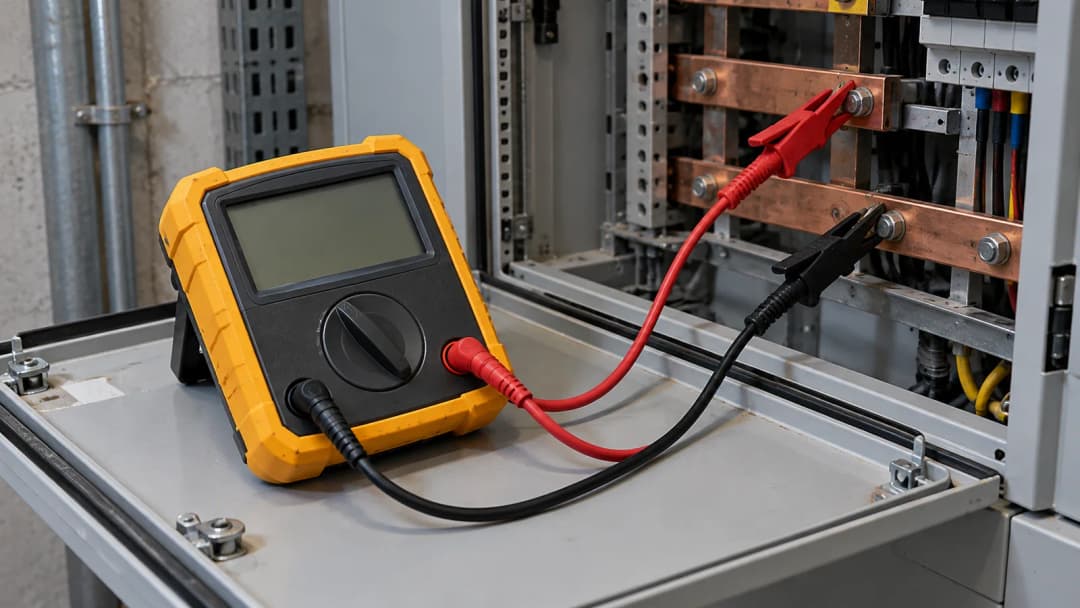
DEWA's acceptance limit for a general electrical installation is 1 MΩ, measured at a maximum of 1000 V DC applied for one minute between live conductors and earth. On photovoltaic circuits the bar is higher: strings must read above 5 MΩ, relaxed to 2 MΩ where there is moisture on the modules. Those three numbers decide whether your inspection certificate passes, and they are the reason an insulation tester is not optional kit on a Dubai site.
This guide covers what the test proves, how to run it without damaging anything, the limits that apply in the UAE, and which instruments actually cover the range.
What the test is actually proving
Insulation resistance testing applies a DC voltage well above working voltage and measures the leakage current that flows through the insulation rather than along the conductor. A healthy cable leaks almost nothing, so the calculated resistance is high — often hundreds of megohms. Insulation that has been nicked by a draw-in, cooked in a hot riser, or sat in a flooded duct leaks more, and the reading falls.
The failure mode matters here more than in temperate climates. Dubai's combination of ambient heat in plant rooms and humidity in basement and coastal installations attacks insulation from both directions. PVC softens and creeps under sustained heat; moisture ingress at a gland or a buried joint shows up as a reading that drops steadily rather than failing outright. A single pass reading of 1.2 MΩ technically passes, but a cable that read 200 MΩ last year and reads 1.2 MΩ now is telling you something that the pass/fail line does not.
The limits that apply in the UAE
These come from DEWA's own inspection and testing guidance. Treat them as the floor, not the target.
| Circuit | Test voltage | Duration | Acceptance |
|---|---|---|---|
| General installation, live conductors to earth | Max 1000 V DC | 1 minute | ≥ 1 MΩ |
| PV strings, including clamps and terminals | Max 1000 V DC | 1 minute | > 5 MΩ |
| PV strings with moisture present on modules | Max 1000 V DC | 1 minute | > 2 MΩ |
Results go onto the Inspection & Testing Certificate that DEWA requires on completion, alongside continuity and earth electrode resistance figures. A missing or inconsistent insulation result is one of the more common reasons a submission comes back.
Running the test properly
- Isolate and prove dead first. An insulation tester will refuse or misread on a live circuit, and a 1000 V DC injection into an energised system is dangerous. Prove dead with a two-pole tester, not a multimeter on its own.
- Disconnect or bypass anything voltage sensitive. Dimmers, electronic ballasts, SPDs, VFD front ends, RCBO electronics and PV inverters can be damaged by 1000 V DC. Where you cannot remove them, test at 500 V and record why.
- Short line and neutral together and test the pair against earth, then separate them and test line to neutral. Doing it in that order catches a shared fault you would otherwise miss.
- Hold for the full minute. Reading at five seconds gives you a flattering number because the insulation is still charging. The one-minute value is the one that goes on the certificate.
- Discharge before touching anything. A long cable run holds a real charge after a 1000 V test. Instruments with automatic discharge do this for you; confirm the display reads zero before you disconnect.
- Record the ambient temperature. Insulation resistance falls as temperature rises — roughly halving for every 10 °C in many cable types. A reading taken in a 45 °C plant room is not comparable with one taken in an air-conditioned riser, and a trend is worthless without it.
Choosing a tester for the job
The deciding factor is the highest test voltage you need, which follows the voltage class of what you are testing rather than personal preference.
| Work | Test voltage needed | Instruments we stock |
|---|---|---|
| Final circuits, domestic and light commercial | 250 / 500 / 1000 V | Fluke 1503, Kyoritsu KEW 3005A |
| Commercial installation testing with continuity | Up to 1000 V plus continuity | Fluke 1507, Kyoritsu KEW 3021 |
| Insulation plus general measurement in one housing | Up to 1000 V | Fluke 1577, Fluke 1587 FC |
| MV cable, motors, switchgear | 5 kV to 15 kV | Fluke 1550C FC, Fluke 1555 FC, Megger MIT1015 |
Two features earn their money beyond the basic range. A timed test that holds and logs the full minute removes the temptation to read early. And a polarisation index or dielectric absorption ratio function — a 10-minute reading divided by a 1-minute reading — tells you whether insulation is merely damp or genuinely degraded, which is the difference between drying a motor out and rewinding it.
Browse the full range of insulation testers, or the high-voltage insulation testers if you are working above 1 kV.
Common questions
Can I use a multimeter instead of an insulation tester?
No. A multimeter measures resistance with a few volts, which will not stress insulation at all. A cable that reads open circuit on a multimeter can still fail at 500 V. The test voltage is the point of the test.
What if a circuit reads just above 1 MΩ?
It passes, but treat it as a finding rather than a result. On a new installation, a reading near the limit usually means a damaged conductor, a wet joint, or a load you forgot to disconnect. Split the circuit and retest section by section to find it.
Do I need a 10 kV tester?
Only if you work on medium-voltage cable, large motors or switchgear. For LV installation work a 1000 V instrument covers everything DEWA asks for, and a 10 kV unit on a final circuit is an expensive way to destroy equipment.
Which Megger or Fluke model is the usual choice here?
For LV certification work the 1507 and the KEW 3021 cover most jobs. For MV the MIT1015 and the Fluke 1550C FC are the two we move most. Send a model number for a same-day price.
Sourcing the instrument
We stock insulation testers from Fluke, Megger and Kyoritsu at our counter on Naif Road, Deira — collect the same day, or we deliver across the seven emirates in one to two working days. We are a supplier and stockist rather than an authorised distributor for any of these manufacturers; what we offer is having all three ranges on the same shelf and a quotation back the same working day. Send a model number on WhatsApp and we will confirm price and availability.
Figures in this guide are taken from DEWA's published inspection and testing guidance. Always work to the current revision for your project.