Thermal Imaging for Switchgear: Delta-T Thresholds
A 15 °C rise over an identical component, or 40 °C over ambient, means act now. Here are the delta-T bands, the camera specs that matter, and the method.
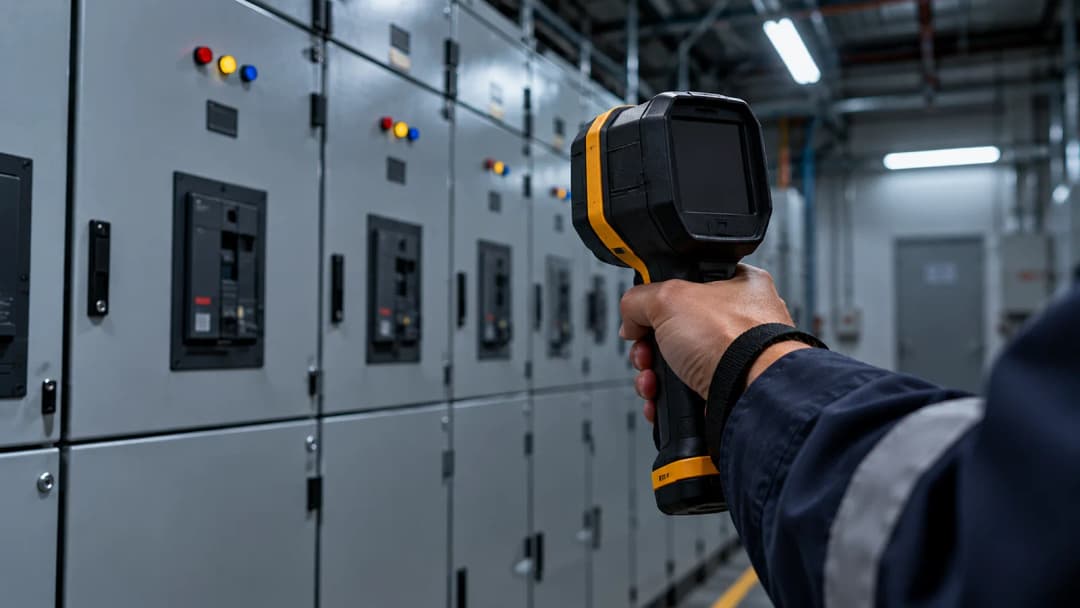
The two numbers that drive an electrical thermal survey are 15 °C and 40 °C: a temperature difference above 15 °C between identical components under similar load, or above 40 °C over ambient air, is treated as a major discrepancy needing immediate repair. Everything below that is graded, scheduled and trended. Those bands come from NETA's maintenance testing specifications, which is the framework most UAE facilities teams and insurers recognise.
This guide covers the delta-T bands, the camera specification that actually matters, how to survey a panel properly, and what the picture cannot tell you.
The delta-T bands
A thermal survey is comparative, not absolute. A busbar at 62 °C means nothing on its own; a busbar at 62 °C beside two identical bars at 44 °C under the same load is a finding.
| Priority | Rise over similar component | Rise over ambient | Action |
|---|---|---|---|
| 4 | 1–3 °C | 1–10 °C | Possible deficiency. Note and monitor |
| 3 | 4–15 °C | 11–20 °C | Probable deficiency. Repair at next shutdown |
| 2 | — | 21–40 °C | Deficiency. Repair as soon as practical |
| 1 | > 15 °C | > 40 °C | Major discrepancy. Repair immediately |
In practice a loose termination on a breaker lug, bus bar or cable tail is the most common Priority 1 finding, and resistive heating at a bad joint can push delta-T past 50 °C over ambient before anything trips.
Camera specification that matters
Marketing leads on resolution. For electrical work, thermal sensitivity and the ability to survey safely from a distance matter more.
- Thermal sensitivity (NETD) of 100 mK or better. This is the specification NETA sets for electrical inspection. A camera that cannot resolve a 0.1 °C difference will not reliably catch a Priority 4 finding, which is the whole point of a predictive survey.
- Detector resolution appropriate to working distance. 120 × 90 is fine for an open panel at arm's length. Surveying an MV switchroom through a viewing window at four metres needs more pixels on target, or you average the hot spot away with its surroundings.
- Adjustable emissivity and reflected temperature. Bare copper and polished aluminium have very low emissivity and will read far cooler than they are. Leaving emissivity on a 0.95 default is the single most common cause of a missed fault.
- Temperature range to at least 400 °C. Severe faults saturate a 150 °C camera, and a saturated image gives you no delta-T at all.
- Radiometric image storage. A file that stores per-pixel temperature lets you re-analyse later and compare against last year. A JPEG of a thermal image does not.
| Use | What to look for | Instruments we stock |
|---|---|---|
| Pocket check on a round | Compact, fast startup | Fluke PTi120 |
| General panel and plant surveys | Good NETD, radiometric files | Fluke TiS20+, TiS20+ MAX |
| Contracted surveys and reporting | Higher resolution, full analysis | Fluke TiS55+, TiS75+ |
| Measurement and imaging together | Meter plus imager in one | Fluke 279 FC |
| Partial discharge and air leaks by sound | Acoustic array | Fluke ii900, ii910 |
Surveying a panel properly
- Load it first. A thermal survey at 10 per cent load finds nothing. Aim for at least 40 per cent of rated load, and record the actual load with the images — a finding without a load figure cannot be compared to anything.
- Set emissivity per surface. Painted steel around 0.95, bare copper closer to 0.05. Where you cannot get a reliable emissivity, apply a patch of matt tape or paint to a non-current-carrying part and reference that.
- Record ambient and reflected temperature. In a 45 °C Dubai plant room the delta over ambient looks very different from the same fault in a cooled switchroom, and the band you report depends on it.
- Shoot square on where you can. Off-angle readings pick up reflections, especially from polished metal and glazing.
- Do not open live panels to get a better picture. Use IR viewing windows, or survey during a planned outage sequence. Arc flash risk is not worth a cleaner image, and the dead-front survey still finds most joint faults.
- Photograph the nameplate. A report that cannot identify which breaker in which board is a report nobody can action.
What thermal imaging will not tell you
It finds heat, which means it finds resistance. It does not find insulation that is degraded but not yet leaking, a developing partial discharge that is not yet warm, or a loose joint on a circuit that happens to be unloaded when you walk past. Pair it with insulation testing and, on MV plant, with acoustic or PD measurement. A survey programme that relies on one technique has blind spots by design.
Common questions
How often should switchgear be surveyed?
Annually is the usual baseline for commercial plant, with critical or heavily loaded boards every six months. Insurers often set the interval, so check the policy before setting a schedule.
Does a higher resolution camera find more faults?
Only at distance. Close up, thermal sensitivity and correct emissivity settings matter far more than pixel count. A well-configured 120 × 90 beats a badly configured 640 × 480.
Can I survey through a closed panel door?
Not through steel. You need an IR-transparent viewing window, or the door open under a safe system of work. Infrared does not pass through metal or ordinary glass.
What is a realistic delta-T for a healthy busbar joint?
A properly torqued, clean joint should sit within a couple of degrees of its neighbours under the same load. Anything past 4 °C is worth noting even though it only grades as Priority 3.
Sourcing a camera
We stock Fluke thermal and acoustic imagers at our counter on Naif Road, Deira, alongside the insulation and earth testers that make up the rest of a survey kit. Collect the same day or take UAE-wide delivery in one to two working days. We are a supplier and stockist, not an authorised distributor, and we quote the same working day — send a model number for price and availability.
Delta-T bands here follow NETA maintenance testing specifications, referenced alongside NFPA 70B for electrical maintenance programmes.