
Fluke 87V vs 88V: Which Industrial Multimeter Should You Buy?
Both are true-RMS industrial meters with the same safety rating. The difference is what the 88V adds for automotive work, and whether you will ever use it.
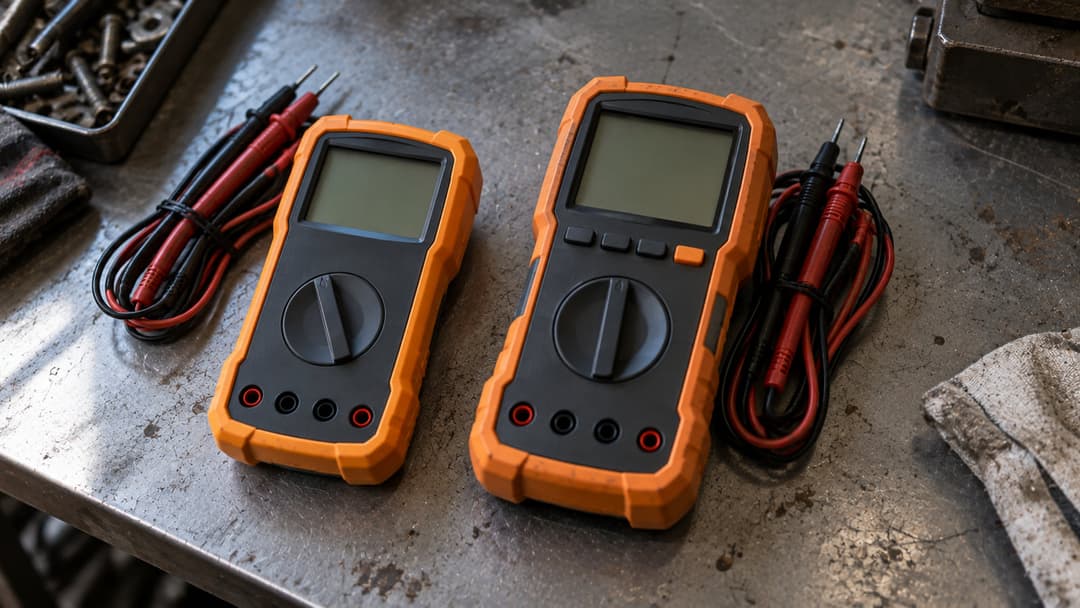
These two meters look almost identical, carry the same safety rating, and sit close together in price. The question is not which is better — it is whether the extra functions on the 88V describe work you actually do.
What the two share
Both are true-RMS industrial multimeters rated CAT III 1000 V and CAT IV 600 V, built around the same rugged case and the same 20,000-count display with an analogue bar graph. Both include a selectable low-pass filter for stable readings on variable frequency drives, peak capture for transients, and a built-in thermometer.
In other words, for general industrial and electrical work the two meters behave the same way. If your work is switchgear, panels, motors and drives, that shared feature set is the whole story.
What the 88V adds
The 88V is built for vehicle and engine work. The additions are aimed squarely at that:
- RPM measurement, using an inductive pickup, for engine speed.
- Pulse width and duty cycle, for injector and solenoid signals.
- Accessories oriented toward automotive diagnostics rather than installation work.
These are not marginal differences in accuracy or build. They are additional measurement types. If you never measure engine speed or an injector pulse, they add nothing to your day.
How to decide
The honest test is a single question: do you work on engines?
If the answer is no — you are an electrician, a maintenance engineer, a commissioning technician, a facilities team — the 87V is the meter. The 88V would give you functions that sit unused on the dial, and a dial with unused positions is marginally slower to work with, not better.
If the answer is yes, and vehicle or generator work is a real part of your week, the 88V removes a second instrument from the bag.
Where the 87V genuinely earns its reputation
Two features do most of the work on an industrial site. The low-pass filter settles the voltage and frequency readings that drives otherwise scramble, which is the difference between a usable measurement and a number that drifts while you watch it. And peak capture records transients as brief as 250 microseconds, which is often how an intermittent fault is finally pinned down.
The built-in thermometer is the quiet third: being able to check a termination temperature without carrying a separate instrument matters more in practice than it sounds on paper.
The short version
| 87V | 88V | |
|---|---|---|
| True-RMS | Yes | Yes |
| Safety rating | CAT III 1000 V / CAT IV 600 V | CAT III 1000 V / CAT IV 600 V |
| Low-pass filter | Yes | Yes |
| Built-in thermometer | Yes | Yes |
| RPM, pulse width, duty cycle | No | Yes |
| Best suited to | Industrial and electrical work | Vehicle and engine work |
For most people reading this, the 87V is the right meter and the money saved is better spent on a decent set of leads and a clamp. See the Fluke range or send us the model number for a same-day price.