
How to Choose a Digital Multimeter: A Buyer's Guide for UAE Electricians
Counts, true-RMS, CAT rating and input impedance decide whether a meter suits your work. Here is what each one actually changes on site.
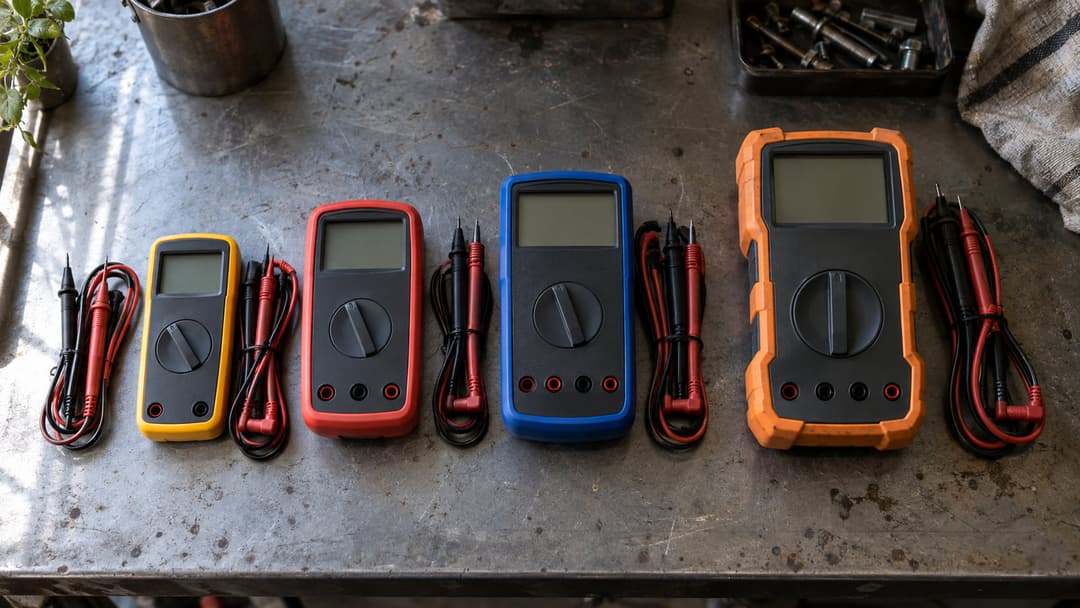
Most multimeter comparisons list specifications. That is not much help when you are standing at a counter deciding what to buy. What follows is the order the decisions actually matter in, for electricians and maintenance engineers working in the UAE.
1. Start with the safety rating, not the feature list
The CAT rating is the only specification on a multimeter that can hurt you. It describes the transient overvoltage the meter is built to survive, and it is paired with a voltage: CAT III 600 V and CAT IV 600 V are not the same thing.
The rule of thumb is distance from the supply. The closer you work to the incoming supply, the more energy is available behind a fault, and the higher the category needs to be.
- CAT II — appliances and socket-outlet circuits.
- CAT III — distribution boards, fixed installation, three-phase motors. The working minimum for most commercial and industrial work.
- CAT IV — the origin of the installation, service entrance, outdoor conductors.
Buy for the highest category you will ever work at, not the one you work at most days. And check the test leads: a CAT II lead plugged into a CAT IV meter gives you a CAT II instrument.
2. True-RMS, unless everything you touch is a perfect sine wave
An averaging meter assumes the waveform it is measuring is a clean sine wave and calculates the rest. On a variable frequency drive, a dimmer, an LED driver or a switching power supply, that assumption fails and the reading is simply wrong — often by a wide margin, and always in a way that looks plausible.
True-RMS meters measure the actual heating value of the waveform. Given how much of a modern building runs on electronic loads, this is no longer an upgrade so much as a baseline.
3. Counts and resolution
Counts describe how finely the display can divide a range. A 6,000-count meter reads to 5,999 before switching ranges; a 20,000-count meter resolves five times more finely on the same range.
For general installation work 6,000 counts is plenty. Where it starts to matter is low-voltage measurement and any work where you are watching for small drifts rather than reading an absolute value.
4. Input impedance and ghost voltages
This is the one that generates the most callbacks. On a long cable run parallel to a live conductor, capacitive coupling induces a voltage on a conductor that is genuinely dead. A high-impedance meter dutifully reports it, and now nobody trusts the instrument.
A selectable low-impedance mode loads the circuit slightly, collapses the induced voltage, and shows you the truth. If you work in occupied buildings or on long runs, treat this as essential rather than optional.
5. What you can usually skip
Capacitance, frequency and diode test are on nearly every meter and cost nothing. Built-in thermometers are genuinely useful and remove a second instrument from the bag. Bluetooth logging earns its keep only if you actually chase intermittent faults — otherwise it is a feature you will use twice.
Matching the meter to the work
| Work | What to look for |
|---|---|
| Commercial buildings, occupied sites | Compact true-RMS, integrated non-contact detection, low-impedance mode, CAT III 600 V |
| Industrial plant, switchgear, drives | Rugged true-RMS, low-pass filter, peak capture, CAT III 1000 V / CAT IV 600 V |
| Field service and HVAC | Compact true-RMS with min/max/average recording |
| Instrumentation | A meter that sources and measures mA loop current |
If you are unsure which of those rows describes your work, tell us what you are testing and where in the installation you are standing. That is usually enough for us to narrow it to two models.
Browse the range in digital multimeters, or send us a model number and we will come back with a price the same day.